
New Energy World™
New Energy World™ embraces the whole energy industry as it connects and converges to address the decarbonisation challenge. It covers progress being made across the industry, from the dynamics under way to reduce emissions in oil and gas, through improvements to the efficiency of energy conversion and use, to cutting-edge initiatives in renewable and low-carbon technologies.
CCS service spending to total more than $50bn globally by 2025
23/3/2022
News

Service sector spending on carbon capture and storage (CCS) developments is set to skyrocket this decade, quadrupling from 2022 to 2025, with cumulative global expenditure over the next three years topping $50bn, according to the latest analysis from Rystad Energy.
Total spending for announced commercial CCS projects in 2022 is projected to hit $4.4bn, up from $2.8bn last year. Outlay is then expected to nearly triple in 2023, topping $11bn for the year. Projections show 2024 and 2025 will see an additional $18bn and $19bn, respectively, bringing the projected total to $52bn by the middle of the decade. These totals only include announced projects, assuming all projects move ahead as planned, and do not account for pilot or demonstration-only developments.
The cash will be spent on a broad range of services related to the installation of the capture unit, transportation of CO2 and its storage. Europe and North America will drive spending, with 63 out of the 84 announced commercial CCS projects expected to start operations by 2025 situated in these two regions.
There are 56 commercial CCS projects already in operation globally, capable of capturing up to 41mn t/y of CO2 across various industries. Based on already announced projects, nearly 140 CCS plants could be operational by 2025, capturing at least 150mn t/y of CO2 if all projects move ahead as scheduled. These projects are currently in various stages of development, including feasibility, concept and construction.
Almost two-thirds of the total service spending will go towards equipping facilities with the CO2 capture component and maintaining operations. Engineering, procurement, construction and installation (EPCI) costs will be the primary driver of spending, contributing about $35bn to the $55bn total by 2025, according to Rystad Energy. Annual EPCI spending is expected to reach $12bn in 2025, a more than 300% increase from the $2.8bn projected for this year.
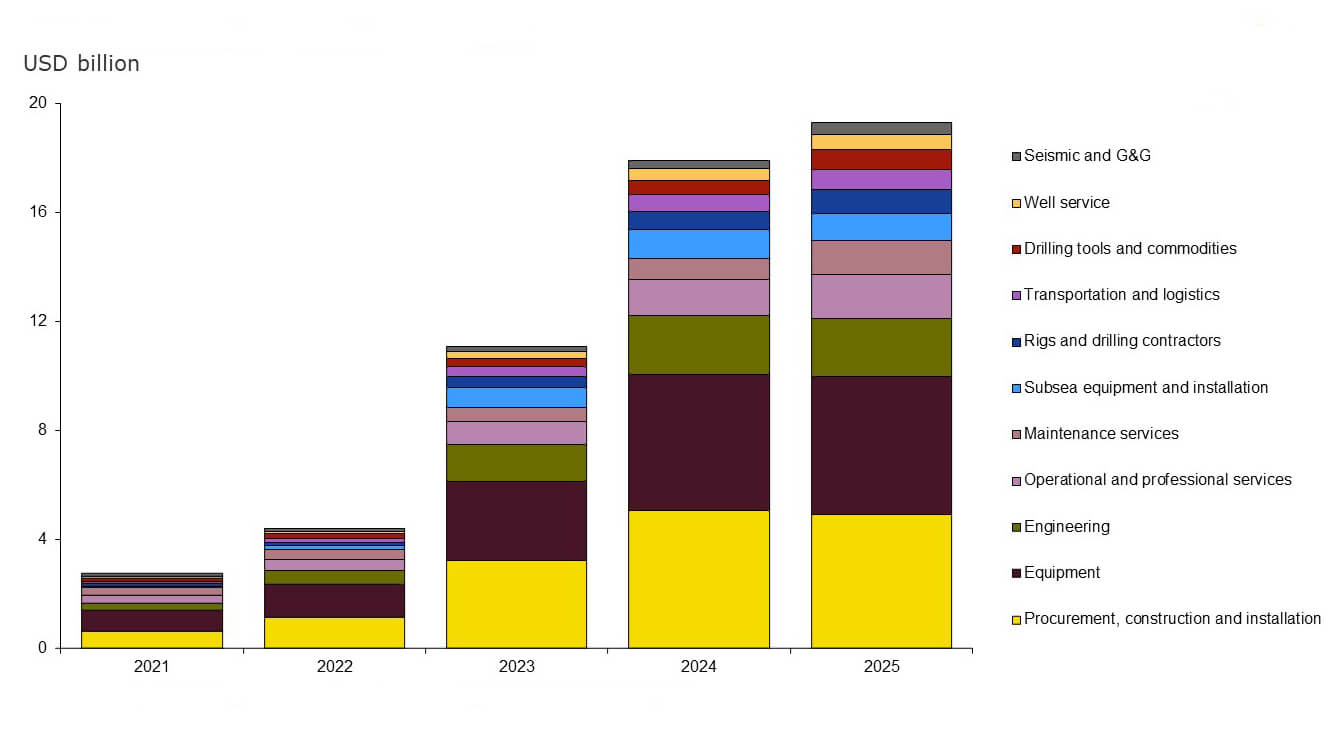
Fig 1: Global CCS service spending by sector, in $bn
Source: Rystad Energy
Transportation – which follows capture of the CO2 – will require service purchases worth $8.5bn through 2025, says the market analyst. The CO2 can be commercially transported in gas and liquid form to the storage area using pipelines, trucks and ships. Within each project and depending on the transport distance and location of the target storage location, the mode of transportation can vary. Pipelines are widely used to transport CO2, and there are 51 operational onshore pipelines, 38 of which are located in North America.
Onshore storage is currently the dominant mode of storage since it is cheaper and less complex. However, there will be an uptick in the number of offshore storage sites driven by Europe, including the Netherlands and the UK, in the coming years, predicts Rystad Energy. There are five operational offshore pipelines, but the number could increase to 50 once the under-construction and planned projects with an offshore storage site become operational. Additional capital will, therefore, be required to lay the necessary subsea pipelines to transport CO2 to storage sites. This will lead to growth in the subsea pipeline, shipping and offshore installation segment in the coming years. Trucks can be used to transport small amounts of CO2 and have the flexibility to collect from and deliver to several locations. Trucks are widely used in countries such as China.
The third and final step in most cases is storage. The process starts with identifying the potential storage location and is followed by drilling wells for injection and monitoring purposes, with associated drilling tools and oil country tubular goods (OCTG) then required. The storage process will incur at least $9bn in service purchases through 2025, says Rystad Energy.
The majority of these new additions will stem from Europe and North America, which account for 85% of the service purchases expected through 2025. The European market will account for more than 50% of the purchases despite having almost the same number of projects in the pipeline as North America. This is because many of the new upcoming projects in Europe will store CO2 offshore. Offshore storage is more expensive as it requires, for example, laying subsea pipelines for transport using pipelaying vessels, and offshore rigs operating at higher rates to drill injection wells, and is coupled with higher labour rates in the region.
The growth in Europe is fuelled by high European Union Emissions Trading System (EU ETS) prices along with favourable carbon policies and support for CCS projects, notes Rystad Energy. The North American CCS landscape is continuing to gain momentum with multiple projects announced in the US and Canada, driven by national incentives and funds supporting the technology.