
New Energy World™
New Energy World™ embraces the whole energy industry as it connects and converges to address the decarbonisation challenge. It covers progress being made across the industry, from the dynamics under way to reduce emissions in oil and gas, through improvements to the efficiency of energy conversion and use, to cutting-edge initiatives in renewable and low-carbon technologies.
Heavy duty transport transition will rely more on hydrogen than batteries, according to new report
6/7/2022
News

The global rush to zero emissions offers the transport sector two choices for decarbonisation, and among passenger vehicles it is clear the choice has already been made in favour of battery electric vehicles (EVs). However, despite some obstacles remaining, the hydrogen fuel cell is expected to dominate in the heavy-duty, long-distance trucking sector, according to Rethink Energy.
According to its latest report, scaling up from passenger vehicles, the larger a vehicle gets – and the more time it is required for uninterrupted operation – the more hydrogen holds an advantage. Citroen, Peugeot and Vauxhall are all set to release fuel cell van models in 2022, with the largest penetration coming from Japan, Korea, and then Europe.
For light commercial vehicles (LCVs), 13.1% of sales will include a fuel cell by 2035, rising to 29.7% by 2050, predicts Rethink Energy. A total of 38.7mn fuel cell LCVs will be on the road at this time – about 22% of the global total – but this market will still be dominated by battery electric, with some 88.9mn EV models in operation, accounting for almost 65% of sales by 2050 and making up 50% of the total global fleet.
In total, the number of internal combustion engine (ICE) LCVs are forecast to fall from 134mn in 2021 to just 49mn by 2050. Scaling batteries to provide sufficient power and range to these larger vehicles poses significant logistical challenges. Emerging hydrogen and e-fuel technologies – providing already accepted refuelling times and range capabilities – will be needed, but will need support and subsidy in their early route to market, says the market analyst, and they will need to establish a broader infrastructure for their widespread adoption.
‘The light commercial vehicle space will be a battlefield where the two styles of zero emissions – battery and hydrogen – will meet,’ comments Harry Morgan, Rethink Energy’s Hydrogen Analyst and lead author of the report. ‘But still it is likely to show a preference towards battery electric, with a similar market structure to the passenger vehicle segment. It is where there is a need for high utilisation rates, and short and infrequent refuelling, where hydrogen can take a significant role.’
Volvo Trucks showcases new zero-emissions truck
In related news, Volvo Trucks has started to test a new hydrogen-powered truck that is claimed to have a 1,000 km range and can be refuelled in just 15 minutes.
The new CO2-neutral fuel cell electric truck powered by hydrogen will join the company’s other decarbonising transport options – battery electric trucks and trucks running on renewable fuels such as biogas – in due course.
The new vehicle’s 1,000 km operational range is comparable to many diesel trucks, according to the manufacturer. Customer pilots will start in a few years from now and commercialisation is planned for the latter part of this decade.
‘We have been developing this technology for some years now and it feels great to see the first trucks successfully running on the test track. The combination of battery electric and fuel cell electric will enable our customers to completely eliminate CO2 exhaust emissions from their trucks, no matter transport assignments,’ says Roger Alm, President of Volvo Trucks.
‘Hydrogen-powered fuel cell electric trucks will be especially suitable for long distances and heavy, energy-demanding assignments. They could also be an option in countries where battery charging possibilities are limited,’ adds Alm.
The fuel cells will be supplied by Cellcentric – a joint venture between the Volvo Group and Daimler Truck. Cellcentric will build one of Europe’s largest series production facilities for fuel cells specially developed for heavy vehicles.
Fuel cell technology is still in an early phase of development and there are many benefits with the new technology, but also some challenges ahead. One of them is large-scale supply of green hydrogen. Another is the fact that refuelling infrastructure for heavy vehicles is yet to be developed.
UK hydrogen electric truck first
Meanwhile, Tevva has launched what is claimed to be the first hydrogen fuel cell-supported heavy goods vehicle (HGV) to be manufactured, designed and mass produced in the UK.
The Tilbury-headquartered company says that by adding a hydrogen fuel cell system to its battery electric HGV design, it can deliver ‘zero emission solutions that will work for the overwhelming majority of fleet operators across a range of industries and sectors’. The fuel cell system tops up the battery, extending the vehicle’s range and allowing the truck to carry heavier loads over longer distances.
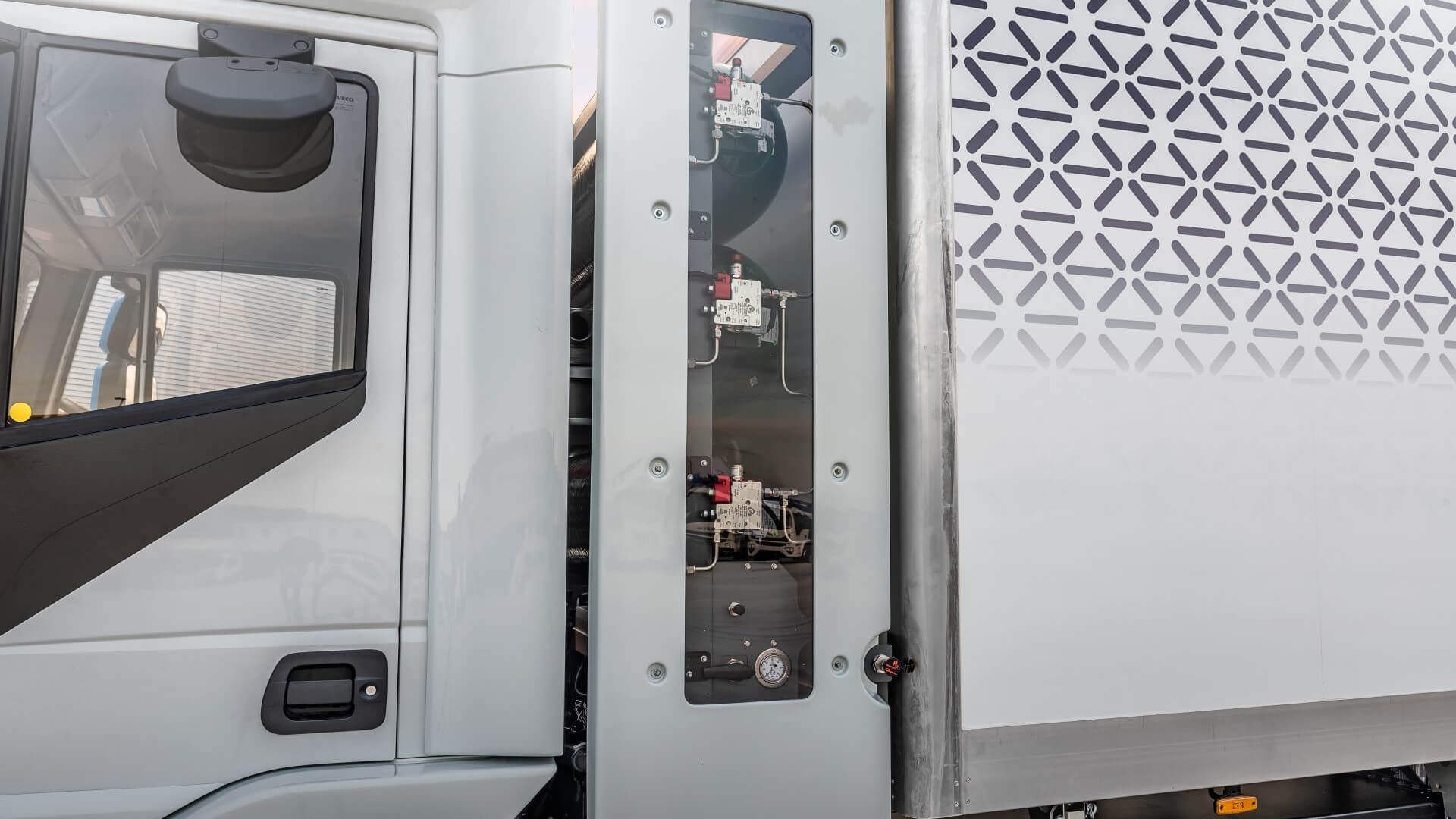
Tevva’s new hydrogen fuel cell-supported heavy goods vehicle is claimed to be the first to be manufactured, designed and mass produced in the UK
Photo: Tevva
One advantage of using the fuel cell as a range extender, rather than the primary source of power, is that it allows Tevva to provide smaller, cheaper and lighter fuel cells and operate these at the highest possible efficiency.
The company says its 7.5-tonne hydrogen electric truck has a range of 500 km and can be refuelled in 5–20 minutes, a similar time to diesel truck refuelling. It can be recharged from fully depleted to 100% in 5–6 hours, easily done within a typical overnight rest break. Initially offered as a 7.5-tonne model, 12 tonne and 19 tonne variants will follow.