
New Energy World™
New Energy World™ embraces the whole energy industry as it connects and converges to address the decarbonisation challenge. It covers progress being made across the industry, from the dynamics under way to reduce emissions in oil and gas, through improvements to the efficiency of energy conversion and use, to cutting-edge initiatives in renewable and low-carbon technologies.
Solar PV recycling market to be worth $2.7bn by 2030
13/7/2022
News

The demand for recycled solar photovoltaic (PV) panel components is set to skyrocket in the coming years as the number of installations surges and the threat of a supply bottleneck looms, according to Rystad Energy.
Recyclable materials from PV panels at the end of their lifespan will be worth more than $2.7bn in 2030, up from only $170mn this year, according to the market analyst (see Fig 1). This trend will accelerate in the coming decades and the value of recyclable materials is projected to approach $80bn by 2050.
PV recycling is still in its infancy but is seen as an essential element of the energy transition, with solar PV waste projected to grow to 27mn t/y by 2040. Rystad Energy’s forecasts show that recovered materials from retired panels could make up 6% of solar PV investments by 2040, compared to only 0.08% today.
Landfills are an easy and cheap option as current resale prices for recycled solar PV materials do not compensate for the transportation, sorting and processing costs. Yet, the rapid growth rate of large-scale utility farms within solar energy could change this. The material supply side is expected to encounter bottlenecks with the growing demand for minerals, and recycling could be a supply relief as panels reach the end-of-life stage.
‘Rising energy costs, improved recycling technology, and government regulations may pave the way for a market where more defunct solar panels are sent to recycling rather than the nearest landfill. Recycling PV panels can help operators save costs, overcome supply chain woes and increase the likelihood of countries meeting their solar capacity goals,’ says Rystad Energy Analyst Kristin Stuge.
Demand for the materials and minerals used in solar PV is set to climb with the energy transition, with higher prices a likely result. The International Energy Agency’s Net Zero Emissions Scenario targets 40% of the world’s power in 2050 being generated by solar energy – equivalent to 19 TW. Rystad Energy’s 1.6°C Scenario, however, predicts that 53% will be solar-generated.
By assuming a 15-year lifespan of a PV panel and analysing installation activity in 2022, Rystad has estimated which regions and countries will benefit most from recycling PV materials in 2037. China is set to account for 40% of global installations this year, and when these panels mature in 15 years, the estimated recycling value will be $3.8bn, out of a $9.6bn global total. India will trail in second place with an estimated $800mn in value, followed by Japan at $200mn.
What can be recycled?
The panel components with the highest value are aluminium, silver, copper and polysilicon. Silver accounts for about 0.05% of the total weight but makes up 14% of the material value. Polysilicon is obtained through an energy intensive process to achieve the concentration needed for solar panel efficiency, reflected in the relatively high resale price. The greatest volume of material is glass, which has a high recycling rate but relatively low resale value.
An influx of minerals is necessary to decarbonise global energy systems and prevent valuable material loss in standardised waste streams. Rystad Energy’s 1.6°C Scenario estimates peak solar energy implementation in 2035 of 1.4 TW. By that time, the PV recycling industry could supply 8% of the polysilicon, 11% of the aluminium, 2% of the copper and 21% of the silver needed to meet demand, by recycling PV panels that were installed in 2020. This recovery potential could ease strains on the mining sector and reduce the solar PV panels’ carbon footprint, comments Rystad.
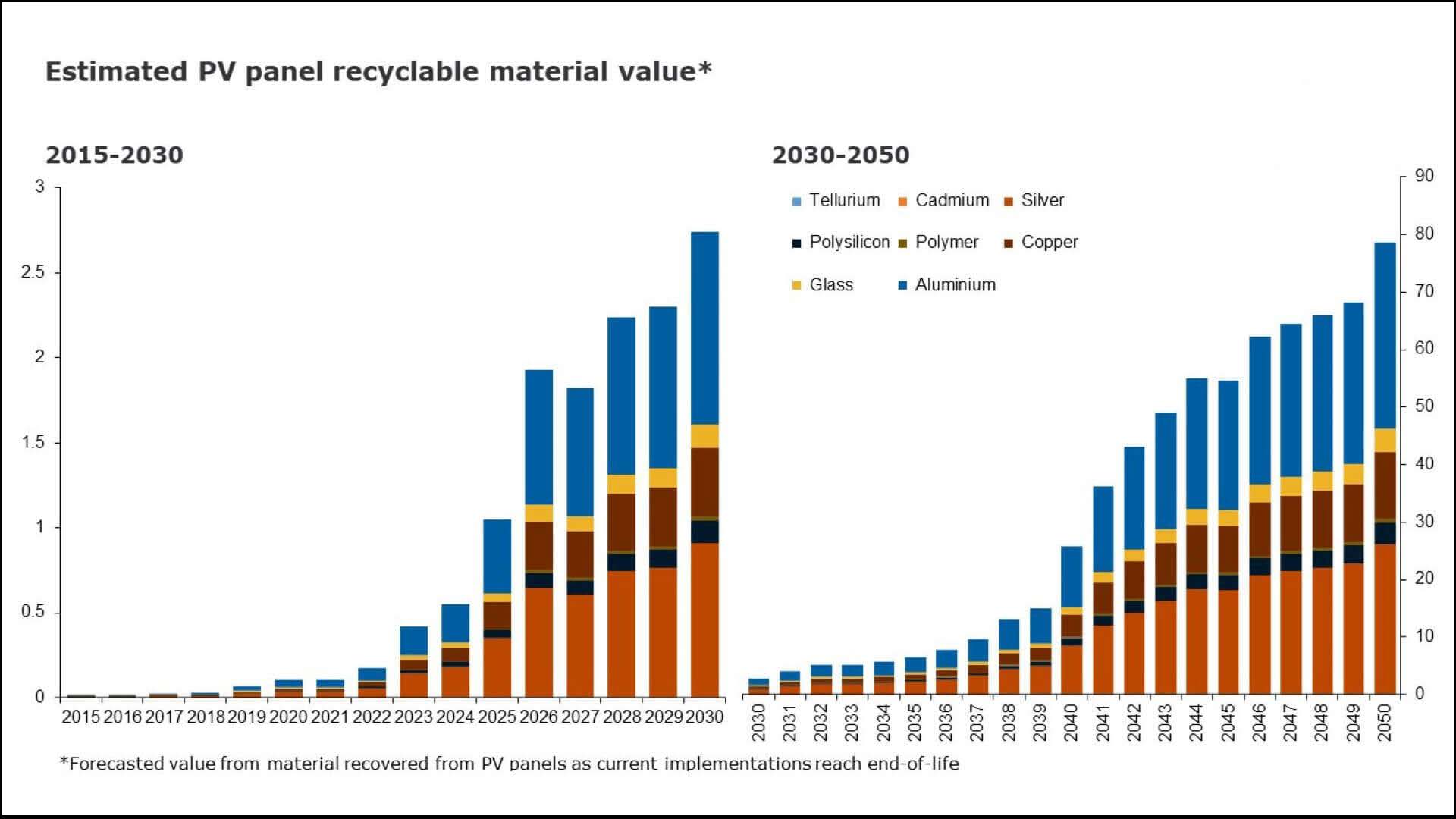
Figure 1: Estimated PV panel recyclable material value ($bn)
Source: Rystad Energy