
New Energy World™
New Energy World™ embraces the whole energy industry as it connects and converges to address the decarbonisation challenge. It covers progress being made across the industry, from the dynamics under way to reduce emissions in oil and gas, through improvements to the efficiency of energy conversion and use, to cutting-edge initiatives in renewable and low-carbon technologies.
First power from world’s deepest fixed bottom wind farm
7/9/2022
News

SSE Renewables and partner TotalEnergies have announced first power generation from the Seagreen offshore wind farm, being built 27 km off the coast of Angus in Scotland.
The first Vestas turbine of a total of 114 was commissioned and connected to the grid on 22 August. The 1,075 MW wind farm is expected to be fully operational in 1H2023.
The £3bn Seagreen project will be Scotland’s largest offshore wind farm and the world’s deepest fixed bottom wind farm, with its deepest foundation due to be installed at 59 metres below sea level in December, says SSE Renewables. Power generated at the wind farm will be exported to the grid via Cockenzie, East Lothian.
TotalEnergies entered into an agreement with SSE Renewables to acquire a 51% stake in the Seagreen project in June 2020. When fully operational, the site will produce around 5 TWh/y of electricity, enough to power the equivalent of 1.6mn households, adds SSE.
Vincent Stoquart, Senior Vice President of Renewables at TotalEnergies, said: ‘We are delighted to announce the start of power generation from Seagreen, our first offshore wind farm in the UK North Sea. This marks a new step in the development of TotalEnergies’ offshore activities capacity. This milestone will contribute directly to our objective of reaching 35 GW of renewable electricity capacity worldwide by 2025.’
Part of SSE plc, SSE Renewables says it is building more offshore wind energy than any other company in the world. The company plans to double its installed renewable energy capacity to around 8 GW by 2026, and has targets to treble capacity to over 13 GW by 2031.
Meanwhile, three new floating offshore wind projects are to be offered seabed agreements following Crown Estate Scotland’s ScotWind clearing process. Clearing saw the ‘NEI’ area east of Shetland made available for ScotWind applicants which met the required standards but who did not secure their chosen location earlier in the leasing process.
The three projects are being developed by Mainstream Renewable Power (1,800 MW generating capacity), Ocean Winds and ESB Asset Development (500 MW each).
Colin Palmer, Director of Marine at Crown Estate Scotland, said: ‘These projects have significant potential to really boost Scotland’s progress towards its net zero targets, including in relation to the opportunity around green hydrogen. Taking these three into account, the 20 ScotWind projects now total up to 27.6 GW.’
However, the granting of seabed agreements is just the first stage of the lengthy process that the projects will have to go as they progress through consenting, financing, and planning stages.
World’s largest wind farm enters full operation
More recently, the world’s largest wind farm – the 1.3 GW Hornsea 2 project – has entered full operation. Comprising 165 wind turbines, Hornsea 2 is located offshore the Yorkshire, UK, coast, alongside its sister project Hornsea 1. Together, the two wind farms will supply some 2.5mn homes and will make a significant contribution to the UK government’s ambition of having 50 GW of offshore wind in operation by 2030.
Ørsted now has 13 operational offshore wind farms in the UK, providing 6.2 GW of renewable electricity for the UK – enough to power more than 7mn homes.
Hornsea 2 makes a significant contribution to Ørsted’s global ambition of installing 30 GW offshore wind by 2030. Ørsted currently has approximately 8.9 GW of offshore wind in operation, some 2.2 GW under construction, and another almost 11 GW of awarded capacity under development including the 2.8 GW Hornsea 3 project.
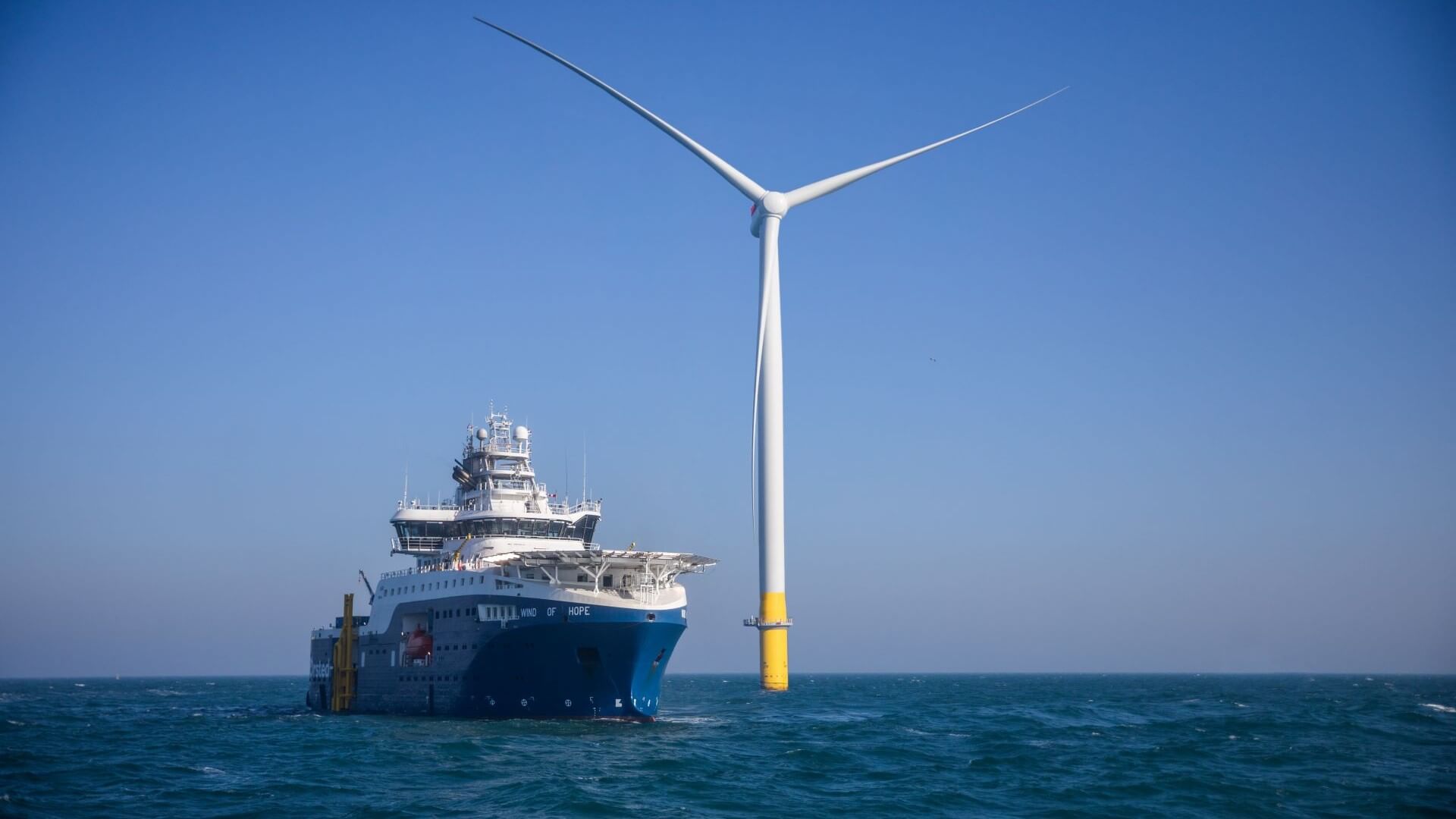
Hornsea 2 makes a significant contribution to Ørsted’s global ambition of installing 30 GW offshore wind by 2030
Photo: Ørsted