
New Energy World™
New Energy World™ embraces the whole energy industry as it connects and converges to address the decarbonisation challenge. It covers progress being made across the industry, from the dynamics under way to reduce emissions in oil and gas, through improvements to the efficiency of energy conversion and use, to cutting-edge initiatives in renewable and low-carbon technologies.
World-first flight for single engine helicopter fuelled by SAF
1/3/2023
News

A Bell 505 helicopter has become the first single-engine helicopter to fly using 100% sustainable aviation fuel (SAF), claims US aerospace manufacturer Bell Textron.
The flight represents ‘a monumental achievement for sustainability and decarbonisation in the rotorcraft industry’, says Michael Thacker, Executive Vice President, Commercial Business, Bell. It was the result of a collaboration between Bell and Safran Helicopter Engines, manufacturer of the Arrius 2R engine on the Bell 505; GKN Aerospace, the fuel system component supplier; SAF supplier Neste; and Virent, a Marathon Petroleum subsidiary that manufactures renewable fuels and chemicals.
Commenting on the flight, Valentin Safir, Executive Vice-President, Programs, Safran Helicopter Engines, says: ‘SAF is one of the key pillars in our strategy to decarbonise the helicopter industry. Our engines are certified to operate on up to 50% SAF and our objective is to certify in the coming years the use of 100% SAF, which can potentially result in carbon lifecycle emissions reductions by up to 80%.’
Neste and Virent collaborated to blend, test and deliver the SAF for this project as a 100% drop-in fuel. SAF, made from used cooking oil or other bio-based feedstocks, typically must be blended with petroleum products because it doesn’t include a component called ‘aromatics’, which is required to meet today’s aviation fuel specifications. Virent manufactures an aromatics component made from renewable plant sugars, which was added to Neste’s neat SAF, eliminating the need to blend SAF with petroleum fuel. The SAF supplied for this test flight is therefore a ‘100% drop-in’ replacement for petroleum-based aviation fuel, requiring no engine modifications, report Neste and Virent.
New $100mn SAF investment fund
Meanwhile, United Airlines, together with inaugural partners Air Canada, Boeing, General Electric, JPMorgan Chase and Honeywell, has launched a more than $100mn investment fund to support start-ups focused on the research and production of SAF, and to scale up SAF supply.
The United Airlines Ventures Sustainable Flight Fund aims to help the global aviation industry reduce carbon emissions and meet the International Air Transport Association’s (IATA) net zero emissions by 2050 target. The industry currently contributes between 2–3% of global CO2 emissions.
United Airlines is also educating consumers about their air travel carbon footprint, giving them the option to take action via United.com and the United app. Claiming to be the first US airline to show customers an estimate of each flight’s carbon footprint in their bookings search, green shading will indicate a lower-carbon option on a per economy seat passenger basis in a customer’s chosen itinerary. A flight’s carbon footprint is measured in kg CO2e and United’s estimates, which could differ from actual flight emissions, are based on aircraft type, flying time, seat capacity and the number of people and cargo on a given flight. The airline is also encouraging travellers to contribute to the SAF fund by offering the first 10,000 customers 500 air miles each for their contribution.
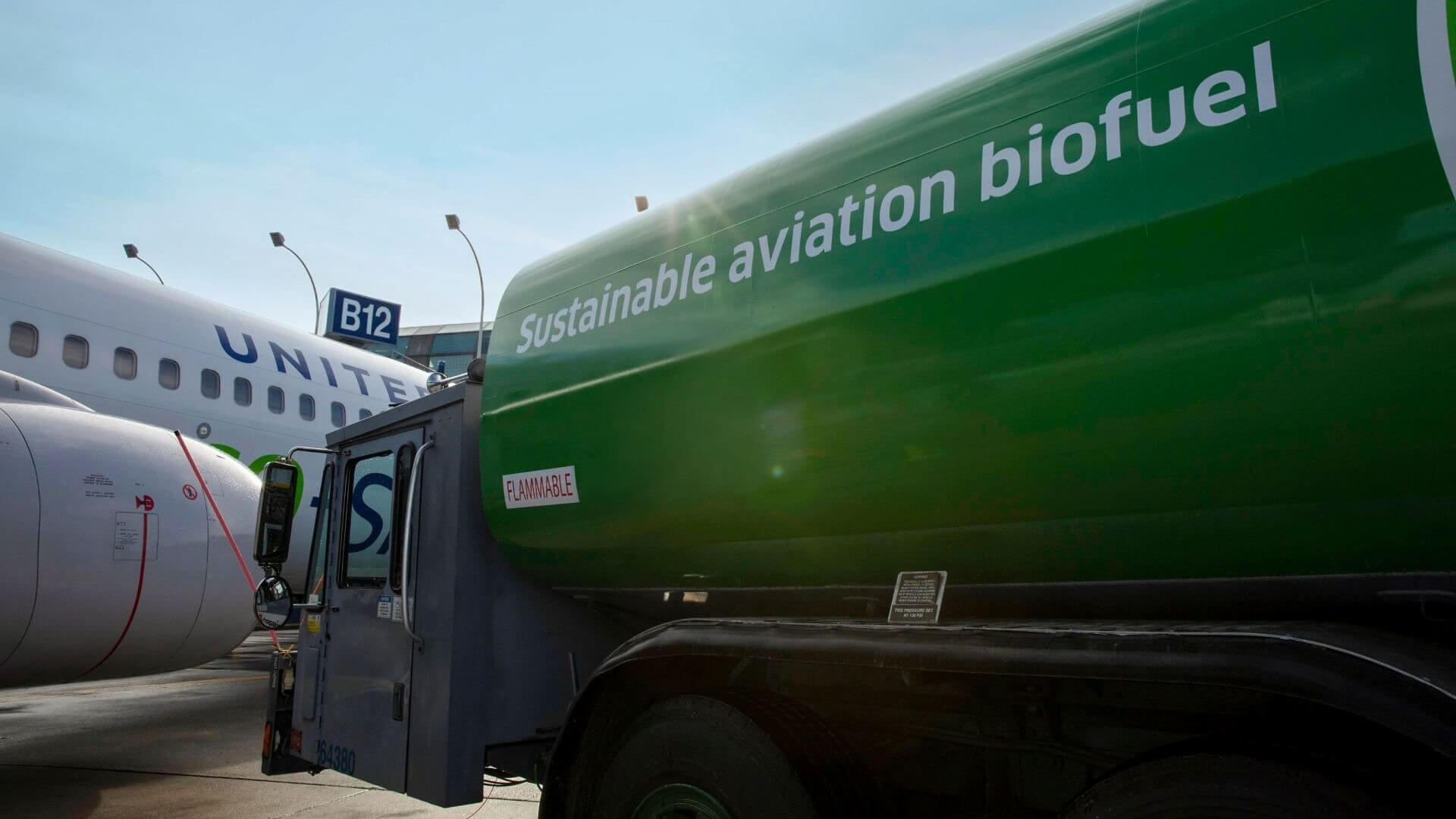
United Airlines aims to be 100% green by reducing its greenhouse gas emissions 100% by 2050, without relying on traditional carbon offsets.
Photo: United Airlines
According to BloombergNEF’s (BNEF) 2022 Sustainable Aviation Fuel Outlook report, 38 of the world’s top airlines have committed to net zero emissions, either by 2050 or earlier. Furthermore, almost 30 have set some form of SAF adoption target, such as 10% of fuel consumption by 2030. While the US and Europe continue to lead the market, other nations are beginning to set out policies, roadmaps and targets to support domestic SAF adoption, including Canada, China and Japan.
New SAF joint ventures and alliances
Elsewhere, in South Africa, Sasol, the global chemicals and energy company, and carbon emission reduction technology specialist Topsoe have signed a memorandum of understanding to establish a 50:50 joint venture to produce SAF and speed up decarbonisation of the aviation sector.
The joint venture will produce SAF derived from non-fossil feedstock, utilising green hydrogen, sustainable sources of CO2 and/or biomass based on Sasol’s Fischer Tropsch and Topsoe’s SAF technologies. These complementary technologies offer multiple pathways to SAF production at scale, claim the partners.
Meanwhile, KBR has unveiled a SAF technology alliance with Swedish Biofuels under which Swedish Biofuels’ ethanol processing technology will also be used to convert CO2 and synthesis gas to SAF.
‘Our technology for producing sustainable aviation fuels will be instrumental in lowering CO2 emissions from the aviation sector and meeting net zero emission targets by 2030 and beyond. This technology is unique as it is ready-to-use real jet fuel as opposed to a blend component,’ comments Dr Angelica Hull, Managing Director, Swedish Biofuels.