
New Energy World™
New Energy World™ embraces the whole energy industry as it connects and converges to address the decarbonisation challenge. It covers progress being made across the industry, from the dynamics under way to reduce emissions in oil and gas, through improvements to the efficiency of energy conversion and use, to cutting-edge initiatives in renewable and low-carbon technologies.
Ukraine prepares for more Russian military strikes against energy system
18/10/2023
News

One year after Russia launched a massive assault on Ukraine’s civilian energy system, DTEK, the country’s largest private energy producer, reports that it is prepared for more attacks this winter.
Working with Ukraine’s Ministry of Energy and the Armed Forces of Ukraine, DTEK has spent seven months restoring energy infrastructure and building defences against future drone, missile and artillery attacks on the country’s power stations, sub-stations and electricity grid.
Between October 2022 and early March 2023, Ukraine’s generating capacity fell to half its pre-war level, with every thermal power and hydro-electric power plant in the country attacked, causing $11bn-worth of damage as millions of ordinary people were plunged into darkness and freezing conditions. Over this winter period, some 9 GW of Ukraine’s generating capacity lay in enemy hands, including 6 GW at Zaporizha nuclear power plant.
Since then, DTEK, which generates around a quarter of Ukraine’s electricity and runs 40% of the country’s grid network, reports that it has restored power supply to 8.9 million households, spending $107mn to repair and restore thermal power plants (TPPs). Repairs on 16 power units (turbines and transformers) have already been completed and the company has reconnected two mothballed power units to provide an extra 500 MW of capacity.
Furthermore, in order to safeguard winter fuel supplies, DTEK has doubled its coal investments to $200mn and imported 210,000 tonnes.
It is also installing additional defensive structures at every TPP to protect them from attack, and well as buying and pre-positioning $36mn-worth of critical equipment at mines, power stations and across the grid network. Investments include the purchase of 224 back-up generators.
In addition, the company has tripled the pace of drilling at its gas business, investing some $151mn, and developing hard-to-hit renewable energy capacity, including the 114 MW Tyligulska wind power plant on the Black Sea, which came online in May 2023.
DTEK plays a critical role in keeping Ukrainians connected to the grid. Its TPPs provide critical load balancing that enable the smooth operation of nuclear and renewable power plants and provide extra winter capacity. As a result, DTEK power stations have been heavily targeted by Russia, suffering over 288 attacks since February 2022.
In response to Russia’s continued tactic of targeting energy infrastructure, the Ukrainian government, as well as energy producers, are changing their approach to energy production, with an increased focus on distributed or on-site energy generation and low-carbon solar, wind, hydro and biomass.
As part of its response to improve Ukraine’s energy security, DTEK is accelerating the development of low-carbon generation such as Tyligulska. Despite its location just 100 km from the frontline, its 19 Vestas turbines dispersed over a wide area make it harder for the enemy to hit and therefore a more resilient source of power. DTEK is currently seeking funding to complete the construction of Tyligulska 2, adding a further 64 turbines and raising the wind farm’s capacity to 500 MW.
At present, some 70% of Ukraine’s power generation is low-carbon, with nuclear accounting for around half of the total, according to DTEK. It also reports that energy consumption is down 30% due to the population exodus and economic slowdown since Russia’s invasion in February 2022.
In line with its long-term ambition to be carbon neutral by 2040, DTEK has committed to only developing low- or zero-carbon infrastructure to replace assets that are lost or occupied during the war.
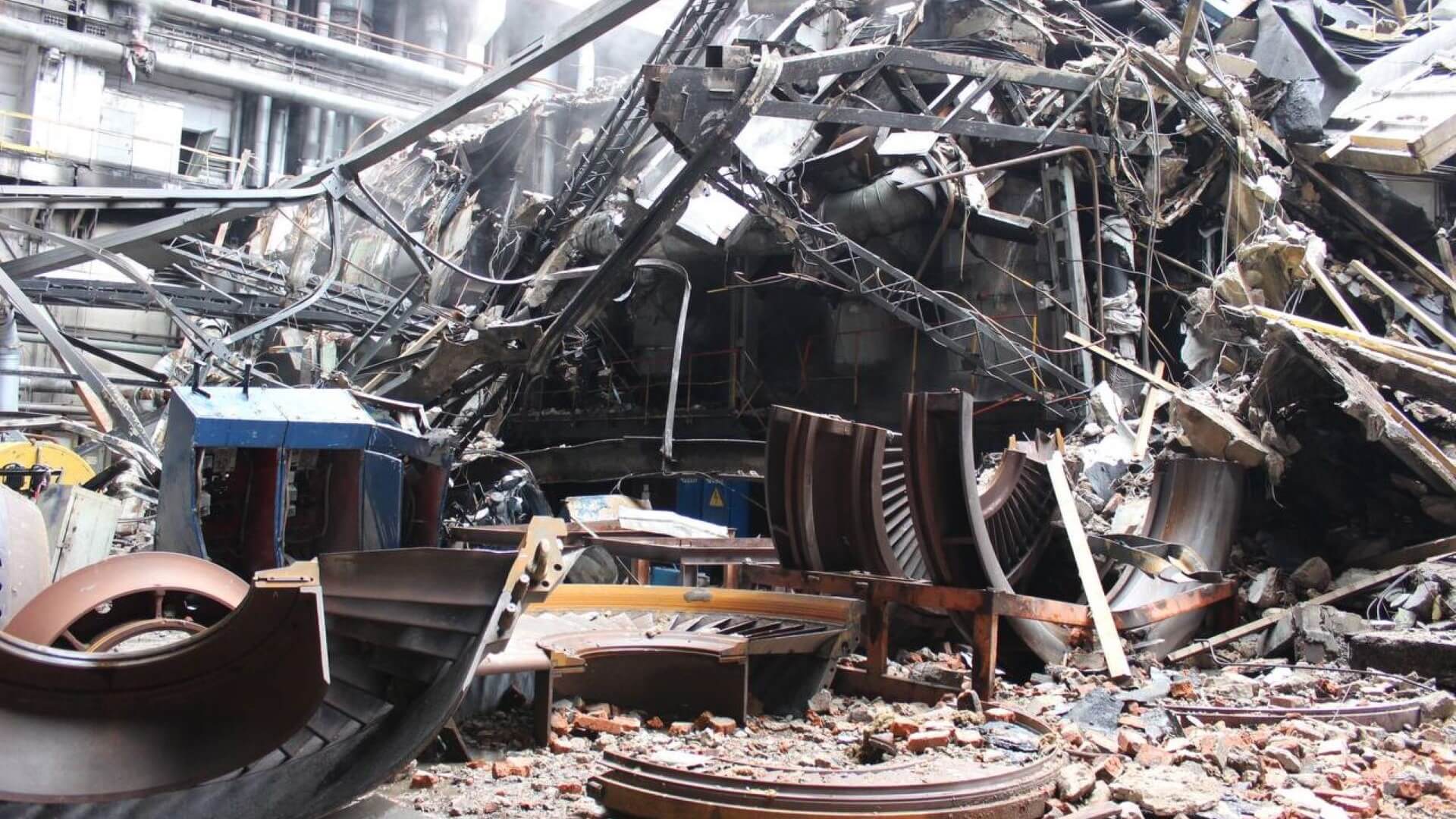
DTEK has committed to only developing low- or zero-carbon infrastructure to replace assets that are lost or occupied during the war, as it works towards being carbon neutral by 2040
Photo: DTEK