
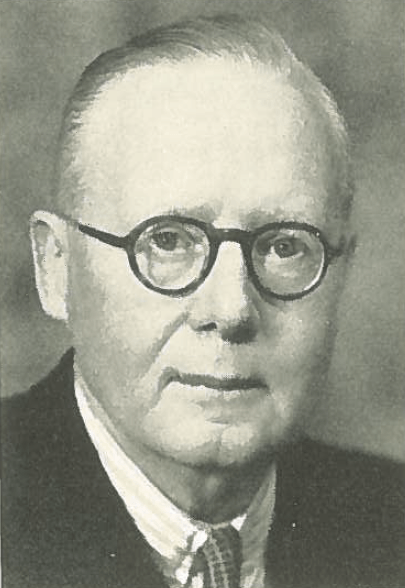
A profile of the architect of the first Statistical Review of World Energy, George Howard Coxon
On headed paper marked 'For Information', the Central Planning Department of British Petroleum (BP) predecessor the Anglo Iranian Oil Company produced The Oil Industry in 1951 Statistical Review as a six-page typed document with a single chart on 29 April 1952. It would take another year for the report to evolve into the more familiar form of a mix of tables, charts and graphs headed by a title in a more familiar order: the Statistical Review of World Oil. That title would persist for nearly the next 30 years, until 1981.
But it all started in 1952 with what was clearly an internal document, marked for distribution to eight company executives. The last page of that document also bears what appears to be the rubber stamped name of GH (George Howard) Coxon.
As the first name connected with the Statistical Review, Coxon (1883-1964), then head of the Central Planning Department, has a claim as its architect, alongside William (Jamie) Jamieson and Dusty Miller, identified as its first authors in earlier research.
Coxon had been a member of the Institute of Petroleum (an antecedent of the Energy Institute) for 25 years, served as Chair in 1946/1947, and remained on the Board since then. Two years later, he would be awarded the Institution's Eastlake Medal for long and meritorious service – the first person to receive that honour.
Coxon had clearly led a colourful life. In 1910, he travelled to Mexico with the Cowdray Group; its founder Lord Cowdray (Weetman Dickinson Pearson), an industrialist and Head of civil engineering contractor S Pearson & Son had founded the Mexican Eagle Petroleum Company a few years earlier. During World War 1, Coxon managed the Mexican Eagle Tampico refinery.
He returned to England with the intention of becoming a career farmer, but this wasn't successful. An obituary published in the Journal of the Institute of Petroleum in 1964 said: 'As everyone who know him will understand, [George Coxon] found that this life failed to satisfy his mental activity.' That did not stop him from farming as a hobby; the account mentions a 'model farm' at his Brockham Court home.
In any event, Coxon joined the Anglo-Persian Oil Company in 1924, first as Assistant Manager of the Refineries Department, and then as its Head until 1943. At that point he was promoted to a role advising the Board on post-war developments as Head of the Central Planning Department, a post he carried on doing for the next decade until his retirement in 1953 after suffering a stroke. That medical condition would prevent him from work on later editions of the Statistical Review.
An obituary in company journal BP Shield in May 1964 observed: 'He was well aware of the fact that the company's prosperity was greatly dependent on its ability to yield products which could command a ready market and his work reflected his great concern for the need of forward planning.'
The Journal of the Institute of Petroleum obituary went even further. It read: ‘His clarity and width of vision and determination that his company should be in the very forefront of the industry was largely responsible for the emergence from being mainly concerned with production and refining to its becoming a fully integrated "major" operating over a large part of the world and spreading its output into a wide range of speciality products, petroleum chemicals, etc.’
